
Don't test outside of spec!
Many of these myths arise because of either lack of full understanding of sampling theory or misinterpreting it. First, it is important to understand a reconstruction or upsampling algorithm cannot be analyzed by just passing an impulse (pop transient) or a step response. Impulse and step signals have their use, i.e., to understand the frequency and time domain response of a system, but they are not the best way to test a reconstruction/upsampling algorithm. In fact, they are the worst signals you could use to do such a test. It is like testing an equipment outside it's operating range and expecting good results! Sampling theory only guarantees perfect reconstruction when the signal is perfectly band-limited. We understand this is the ideal case and no signal is perfect, so what would be a better test signal? Choose your pick:
- Pure impulse or step: Impulse or step signals are not band limited and have infinite bandwidth and are the polar opposite of what is guaranteed to work.
- impulse or step that is band-limited: Impulse or step that are band-limited, need not be perfect, they should have passed through a low pass filter similar to what ADC would do. Granted, they will still have some aliasing and ringing, but at least it is a test signal that is closer to what a music signal is and also does not totally disregard the conditions for prefect reconstruction. Even if the low pass filter is not a great one, it is still infinitely better test signal.
One example of incorrect testing of resampling algorithms is creating Dirac pulses (pop transients) at high rate (say 352.8k), convert those to 44.1k using the algorithm under test, and finally convert those back to the original rate (352.8k). Dirac pulses do not exist in recorded music signals. Mic pop or clip may be, but they have to pass through the ADC first, which will band limit such pops or transients. Digital reconstruction is about reconstructing the original signal from sampled analog signals that are band-limited, a dirac pulse has no place in such a test as it is of a purely digital origin. The right test would have been to use a filter similar to the ones typically used in an ADC to convert the Dirac pulses from the high rate to 44.1kHz. Then use that signal as an input for testing the reconstruction algorithms.
Bottom line: If an upsampling algorithm is developed based on using non-band-limited signals to test its accuracy (which violates the very basic requirement for reconstruction), it would be calibrated quite differently. It is the equivalent of using English units on a system designed with metric units in mind.
Three wrong reasons.
Here are some common misconceptions associated with resampling the PGGB way (i.e., Non-apodizing, using all the information, narrow transition band with high attenuation).
-
Wrong reason 1: Rings like a bell (maybe for a bat).
It is often claimed that the steep and narrow low pass behavior of PGGB in the frequency domain will result in audible ringing in the time domain. This is simply not true, there will be no ringing if the signal is band-limited (i.e. if it only contains frequencies that are less than half the sample rate). No signal is perfect, if the music was recorded and already went through an ADC, then it is already band-limited as it cannot contain any frequencies above half the sample rate. For CDs, the only content in music that can trigger ringing is one exactly at 22.05kHz where there is very little present because the ADC already attenuated it. The exception is clipped music during post processing, but here too, any ringing one can observe will be exactly at 22.05kHz for CD rates, way beyond normal human hearing (more on audibility).
The whole idea of ringing is way exaggerated (because PGGB's corner frequency is exactly at half the sampling rate). Any ringing one may see will be at 22.05kHz because of the residual energy at the corner frequency left by the ADC, this will not be any more (in peak level) than what you may find with relatively short filters. Any ringing that is already present because of the ADCs filter is left untouched by PGGB and this too is beyond the audible range.
It is easy to demonstrate this with a simple example. We created a 44.1kHz impulse train with multiple, closely spaced Dirac ('pop') transients like the one below.

Then to make this an acceptable test signal, we passed it through an IIR filter with a corner frequency at 21kHz to make it band-limited and create a 44.1kHz test file. This is not a perfect band-limited signal, but it is a much better test signal. You can see the band-limited impulse signal below. You will see it is not perfect, but it still retains the two transients, and as expected it shows the time domain response of the ADC filter. It is not an infinite band-width signal anymore.

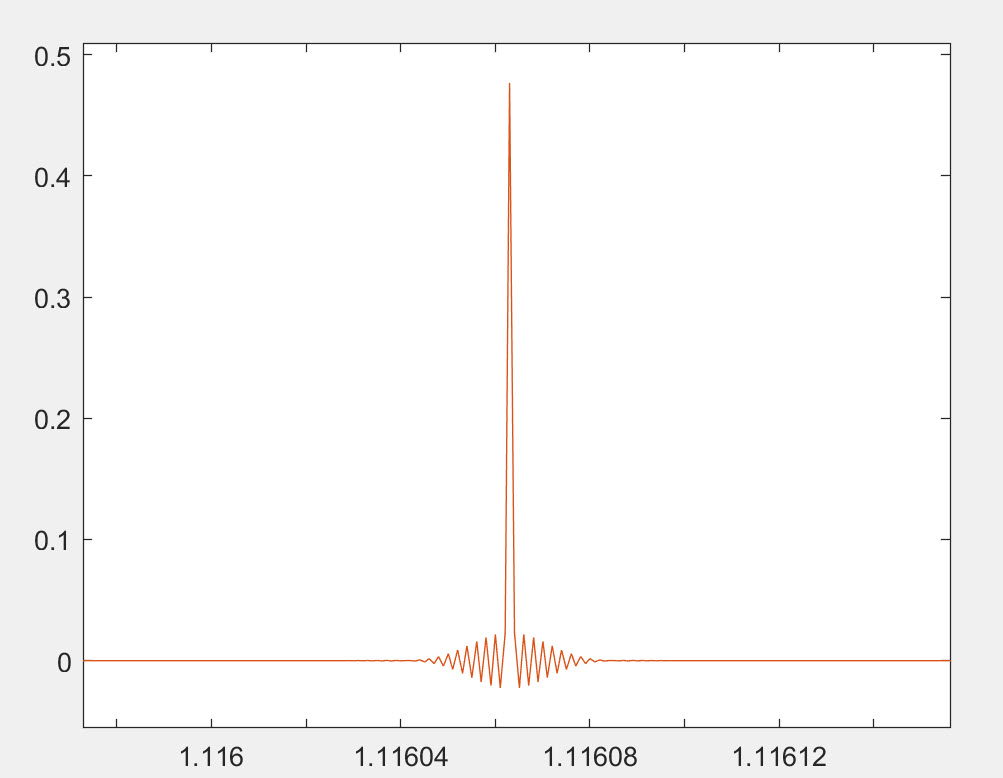
We then used PGGB to upsample it 16x using default settings and 128bit precision and created a 705.6kHz upsampled file. We then used a short linear phase Gaussian apodising filter to upsample to the same 705.6kHz. The Gaussian filter we used is a short Gaussian polyphase sinc filter, the Gaussian filter's time domain response is provided below.
Below we show the results (you can click on the image to make it bigger). Blue (PGGB), Red (Short Gauss) and Yellow is the original. We only zoomed in on one set of transients, but the same is true with all of the transients. You will notice that:
- You can make out the two transients clearly in all three signals
- There is some pre-ringing in the PGGB upsampled signal, this is expected because the band-limiting filter is not perfect, but you can see very little. Which again is beyond the audible range to cause any change in perception of the transient.
- Ironically, there is pre-ringing even in the short Gauss upsampled signal and this is more than what you see with PGGB. To be fair, you will not hear this either.

We zoom in on the pre-ringing portion of the first transient to show the time domain response of the three signals. Here you can clearly see the pre-ringing in the short gauss signal is more than the PGGB signal

Now let us repeat the above test with a real track. For this test we chose a 44.1kHz track that has a lot of clean transients and also contains clipping. The track is '08 Bright Mississippi' from the album The Roy Haynes Trio Featuring Danilo Perez And John Patitucci and was downloaded from Qobuz. We upsampled this track to 705.6kHz using PGGB and short Gaussian polyphase sinc filter, the same as the one we used above. We set the gain to -1.5dB to prevent limiting or clipping and then scaled it back by +1.5dB so we can compare the signals. We also used Gaussian dither for both PGGB and the short Gauss filter to make the comparison fair. The time displayed on the x axis is in seconds and will match the time in the original track. We zoom in on a section where there was a rim hit and the track clipped. Below we show the results (you can click on the image to make it bigger). Blue (Original), Red (Short Gauss) and Yellow is the PGGB. You can see that:
- PGGB does a near perfect job of reconstruction, passing through each of the original samples even when they clipped.
- The short Gaussian filter both undershoots and overshoots compared to PGGB, this very similar to what we demonstrated previously regarding pre-ringing.
- It is very easy to see that PGGB does better even when the signal clipped, because the signal has been band-limited already.

The only time significant ringing can be shown is when it is either an artificial signal (such as an impulse, step) with no band-limiting or if post processing causes clipping. Even if clipping is present this ringing is at half the sample rate which for CD is 22.05kHz, which is beyond the human hearing range, it does not affect signals in the audible range, and is barely noticeable!
So, if someone listens to a whole lot of artificial signals instead of music, or a lot of clipped music, and they have an extended hearing range beyond 20kHz, we can understand their concern. But for the rest of us, it is a non-issue.
-
Wrong reason 2: Blurs transients (show us your math).
It is claimed that long linear filters will cause transient blurring because they are using information both from the future and the past to reconstruct transients and hence both future and past samples could potentially affect a transient that is being reconstructed presently. First, PGGB does not use such filters, so this argument is moot. But even if it did, the argument is pure conjecture without a mathematical basis. If this were true then the whole sampling theorem would fall apart because it is built on the premise of being able to use infinitely long sinc based linear filters to perfectly reconstruct band-limited sampled signals. Anyone claiming so should support their argument with a mathematical proof.
It is fairly simple to demonstrate this with real music tracks, but we chose the more dramatic example of band-limited impulses we used previously. We then used PGGB to upsample band-limited, closely spaced Dirac pulses (pop transients) at 44.1kHz to 705.6kHz using default settings and 128bit precision. We also used a short minimum phase filter which is recommended by some as an ideal filter for music containing strong transients such as pop and rock. minimum phase version of short polyphase sinc filter, the filter's time domain response is provided below.

Below we show the results (you can click on the image to make it bigger). Blue (PGGB), Red (short mp) and Yellow is the original. We only zoomed in on one set of transients, but the same is true with all of the transients. You will notice that:
- You can make out the two transients clearly in the original signal and the one upsampled by PGGB
- The short mp filter which is recommended for music with transients ironically is the one that blurs the transients!
- The only saving grace for short mp filter is that there is no pre-ringing (which is beyond the audible range anyway, but it comes at the huge cost of post ringing and blurred transients!

Now let us repeat the above test with a real track. For this test we chose a 44.1kHz track that has a lot of clean transients, the same one as before. The track is '08 Bright Mississippi' from the album The Roy Haynes Trio Featuring Danilo Perez And John Patitucci and was downloaded from Qobuz. We upsampled this track to 705.6kHz using PGGB and minimum phase version of short polyphase sinc filter, the same as the one we used above. We also used Gaussian dither for both PGGB and the short Gauss filter to make the comparison fair. The time displayed on the x axis is in seconds and will match the time in the original track. We zoom in on a section where there was a clean transient when two drum sticks were hit together. The results are shown below (you can click on the image to make it bigger). Blue (Original), Red (Short mp) and Yellow is the PGGB. You can see that:
- PGGB does a perfect job of reconstruction of the transient, passing through each of the original samples.
- The short mp filter misses the start of that transient, overshoots and distorts.
- It is very easy to see that PGGB does a perfect job of reconstructing transients, there is no blurring.

-
Wrong reason 3: Oversampling filters affect outcome only above audible band (why so naive?).
It is sometimes argued that ringing that is outside of human audible range, can have audible effects on the in-band music. The reasoning given is that, if this were not true, all oversampling filters and all DAC's internal upsampling should sound the same, because they only affect the out-of-band signal. This is a rather naive argument that focuses only on the frequency domain! it assumes these filters do not affect the time domain transients, transient reconstruction and reconstruction of small signals. All these filters sound different not because we are super human and suddenly hear above 20kHz. While evaluating DACs or digital oversampling filters, it is important to focus on time domain cues such as depth, layering, resolution and transient quality, not tonality. Because every change we make to the reconstruction algorithms affect how the transients are reconstructed in the time domain and in turn, affects our perception of transients and the construction of the virtual soundscape.
This too is very easy to illustrate with the very same example that we used previously. We compare the original band-limited signal (yellow) with the PGGB upsampled signal (Blue) and the short mp upsampled signal (Red).
- You can clearly see how the transients are reconstructed differently by PGGB and short mp filter
- The short mp filter which is recommended for music with transients blurs the transients, while PGGB preserves them just fine.
- PGGB will sound different from short mp filter not because of any pre-ringing that is beyond the audible range, but because it is more faithful to the original transients. However short mp that blurs transients will sound flat lacking depth (which may be fine for some music like Rock). The blurring of transients that can lump the energy in to 'clumps' could give the perception of stronger transients, and it is a smoother and more forgiving sound. For that reason it could still be good for music such as rock and pop.
Now let us repeat the above test with a real track using the same one as before. The track is '08 Bright Mississippi' from the album The Roy Haynes Trio Featuring Danilo Perez And John Patitucci downloaded from Qobuz. We upsampled this track to 705.6kHz using PGGB and minimum phase version of short polyphase sinc filter, the same as the one we used above. We also used Gaussian dither for both PGGB and the short minimum phase filter to make the comparison fair. The time displayed on the x axis is in seconds and will match the time in the original track. We zoom in on a section where there was a clean transient when two drum sticks were hit together. The results are shown below (you can click on the image to make it bigger). Blue (Original), Red (Short mp) and Yellow is the PGGB. You can see that:
- PGGB does a perfect job of reconstruction of the transient, passing through each of the original samples.
- The short minimum phase filter misses the mark many times, overshoots and also distorts.
- PGGB clearly demonstrates better reconstruction accuracy here. The obvious change in shape of the reconstructed waveforms will have an audible effect.
As another example, we use the same track again, but we chose a relatively quiet part of the track and we upsampled this track to 705.6kHz using PGGB and short Gaussian polyphase sinc filter. We also used Gaussian dither for both PGGB and the short Gauss filter to make the comparison fair. The time displayed on the x axis is in seconds and will match the time in the original track. Below we show the results (you can click on the image to make it bigger). Blue (Original), Red (Short Gauss) and Yellow is the PGGB. You can see that:
- The Magic of Whittaker-Shannon interpolation formula guarantees near perfect interpolation, passing through each of the original samples even for this relatively low level signal.
- The short Gauss filter reconstructs differently in comparison which is easily observable in time domain, but the differences are small.
- It is very easy to see that PGGB reconstructs low level signals differently, and why they could be audibly different be it transients or low level detail.

How oversampling filters affect the audible band.
One way to illustrate how oversampling filters can affect the outcome in the audible band is by plotting the difference between the same audio track that was upsampled with two different oversampling filters in both time domain and in the frequency spectrum. But there are a few challenges in accomplishing this:
- The first challenge is it is very hard to align the two upsampled signals perfectly at a sample level to do the comparison. Depending on the upsampling algorithm used, they could introduce a sub-sample shift that would make the differences look much larger than they truly are. The solution is not to try and align the signals by correcting for the sub-sample shift. This is because, any processing can alter the signals we are trying to compare and invalidate the comparison. Since PGGB does not introduce a sub-sample shift, the only way to do this comparison is to choose a filter that does not introduce a sub-sample shift, so we chose the sinc based halfband filter.
- The second challenge is that though we can relatively easily plot the differences in time domain, it is harder to show the differences in the frequency spectrum using FFTs. This is because, subtle yet audible differences in the audible range get averaged out.
The best way to illustrate this is instead look at the reconstruction error spectrum of the difference between the two upsampled signals. This is done by taking the difference between the two upsampled signals and then plotting the frequency spectrum of that difference. This is discussed in detail in the reconstruction accuracy section.
Did we pretend Gibbs phenomenon did not exist and defy physics?
Please do not jump to any such conclusions. If you are wondering Gaussian filters have the most compact time-frequency footprint, then how is it plausible that PGGB has less peak ringing than a short Gaussian filter? As far as the plots go, what you see is what you get, so it is mathematically possible. The answer lies in the corner frequency. The Gaussian filter we used is a short Gaussian polyphase sinc filter (it is not a minimum phase filter), the Gaussian filter's time domain response is provided below.
The Gaussian filter is linear, and apodizing and has a corner frequency earlier than the Nyquist, while PGGB has a corner exactly at 22.05kHz. Any ringing you see in time domain is the result of the filter having to dissipate the energy beyond its cutoff frequency. So as the filter's cutoff frequency increases, the ringing will become more localized in time (i.e., will also increase in frequency) because it only needs to dissipate the energy that exceeds the cutoff frequency, everything else just passes through. So PGGB will ring exactly at 22.05kHz for CD rates and every other frequency just passes through.
An apodising filter has to deal with all the leftover energy starting from its cutoff frequency till the Nyquist that was left unfiltered by the ADC which will be more than what PGGB has to filter. While PGGB has to deal with whatever little energy that is left at the Nyquist after the ADC has already done what it can. So, it is not entirely surprising that you see less ringing with PGGB on a reasonably band-limited signal. Here by 'less' we mean the peak magnitude of pre-ringing (after all, the peak magnitude prior to a transient is likely to affect transient perception, if it is even audible!). Ultimately this is all about law of conservation of energy. A short filter has to dissipate the residual energy past its corner frequency within its time domain footprint, the shorter it is, the more it has to dissipate within the short duration. So this is a function of both the length of the filter and its corner frequency. The peak pre-ringing for PGGB can be less, though the duration can be longer, with a lower magnitude. So we did not cheat Gibbs, and again this is all beyond the audible range.
Of course, the less performant the ADC filter is and you push the corner frequency of the ADC filter further out you will see more ringing with PGGB till the ADC's filter becomes a Dirac pulse and the signal is not band-limited any more. What these examples illustrate is that testing with Dirac pulses and making blanket statements about ringing and their audibility shows a fundamental lack of understanding of sampling theory.
There is so much misinformation about what is the correct way to test a resampling algorithm, we perfectly understand if you do not trust us. Feel free to repeat these experiments with the band limited test file we used: Band-limited 44.1kHz impulse train and check for yourself using your preferred upsamplers.
TLDR: While a close-to-ideal reconstruction algorithm such as one used by PGGB may cause ringing beyond the audible range, a non-ideal filter, be it short or long, will affect the whole audible band with poor transient reconstruction and can be audible.